
Blog post by Keaton Fletcher & Blog edited by Courtney Keim
December 2025
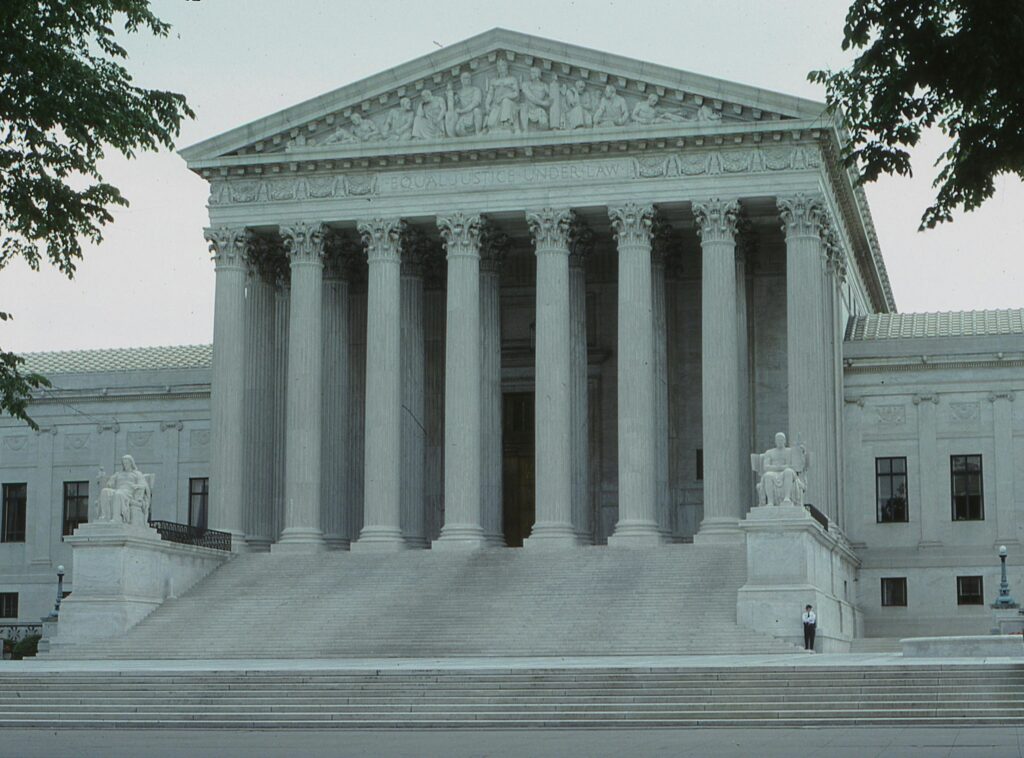
A recent U.S. Supreme Court ruling (Noem v. Vasquez Perdomo) enabled U.S. immigration officers in Los Angeles County to continue detaining and questioning individuals, “based on the following factors or combination of factors: (i) presence at particular locations such as bus stops, car washes, day laborer pickup sites, agricultural sites and the like; (ii) the type of work one does; (iii) speaking Spanish or speaking English with an accent; and (iv) apparent race or ethnicity)” (pp. 2-3). Dissenting, Justice Sotomayor highlights many examples of this occurring including when, “In Glendale, nearly a dozen masked agents with guns “jumped out of . . . cars” at a Home Depot, and began, “chasing” and “tackl[ing]” Latino day laborers without “identify[ing] themselves as ICE or police, ask[ing] questions, or say[ing] anything else.”” (p. 3). Other examples of detention and questioning include a U.S. citizen being held against a fence with his arm behind his back, and another being taken to a warehouse for questioning. Although much attention has rightfully been paid to the role that apparent race and ethnicity play in this discriminatory practice, relatively less has been focused on the role that one’s occupation may play.
This ruling makes clear that one’s occupation, in isolation or in combination with other factors, can currently be used as legal grounds upon which government agents can detain, question, and possibly deport someone. For example, Justice Sotomayor notes that, “White House Deputy Chief of Staff Stephen Miller reportedly […] directed [officers] to target “Home Depot” and “7Eleven” stores” (p. 5) and that in the process of these hearings, the government noted, ‘[c]ertain types of businesses, including car washes, have been selected for encounters because past experiences have demonstrated that illegal aliens utilize and seek work at these locations.’ (p. 5). This inherently makes work even more precarious for individuals working in these jobs that may be classified as “lower status (lower wage, lower skilled)” (Kossek & Lautsch, 2018, p. 6).
Allan et al. (2021) define precarious work as “work that is unstable and insecure in the continuity and quantity of work, restricts the power of workers to advocate for change, and does not provide protections from workplace abuses and unsafe working conditions” (p. 2). Although within the confines of OHP research we often think about precarious work as a job or occupational feature, legal and economic structures can also create precarious work arrangements. Landsbergis et al. (2014) explore this with a focus on job insecurity and instability, noting that individuals in lower socioeconomic positions as well as immigrants and racial or ethnic minorities are disproportionately exposed to job insecurity and other work stressors (e.g., minimal control, long work hours, shift work, lack of social support).
The ruling in Noem v. Vasquez Perdomo (2025) further undermines the power of workers in industries with a history of hiring people regardless of their immigration status. It may be the case that workers in these occupations with a history of employing immigrants, regardless of their actual immigration status, may be hesitant to report unsafe working conditions, attempt to unionize, or advocate for higher pay for fear that their occupation may be targeted by the federal government. On a similar note, this calls to mind the impact of perceived power differentials on the presence of sexual harassment. Kundro and colleagues (2022) found that customers were more likely to sexually harass workers if they perceived tipped employees as having less power (indicated by dependence on tips and emotional display requirements). Imagine a circumstance in which an employee on a construction site is not paid for their work, or is sexually harassed by their supervisor. If they report this to authorities, they risk federal immigration officers also being called in to sweep the worksite, detaining, questioning, deporting, and/or fining them and their coworkers. For example, a legal resident was recently fined $130 dollars for not physically having his immigration papers on him during an immigration sweep in Chicago (Pratt, 2025).
Again, this ruling makes work more precarious for all workers, regardless of race or immigration status, in industries that stereotypically have higher rates of undocumented workers. By formally, albeit indirectly, creating a class of workers who are legally endangered by advocating for themselves, this ruling undermines the safety and security of all workers in these (typically low-wage) occupations, and may also further stymie wages in these industries by reducing the ability for workers to advocate for higher pay or organize without fear of legal trouble. This is noted by reporting on a recent ICE raid in Bellingham, Washington: “[investigators] argued employers hire people without legal status, so they can pay workers a lower wage. Those workers, in turn, are less likely to complain about working conditions — they don’t want to draw attention to themselves.” (Álvarez, 2025). Research supports aspects of this. For example, Flynn and colleagues (2015) found that undocumented Latino immigrants in the U.S. perceive their immigration status and the economic and legal vulnerability associated with it as negatively impacting their safety at work.
As occupational health psychologists, we have a responsibility to discuss how our science intersects with the current political climate. We have a responsibility to advocate for practices that advance, not limit, the health and wellbeing of workers, even if (or arguably especially if) these limiting policies come from governments rather than organizations. Specifically with regard to undocumented workers in the U.S., Lyon (2004) argues for “equal treatment for unauthorized workers” stating, “Employment protections must be equally accorded to workers […] because the United States is obliged under international law to provide these protections for moral and humanitarian reasons” (p.572). Practically, Moyce & Schenker (2018) suggest implementing improved and innovative safety trainings, policy changes such as creation of migrant welfare funds or increased nongovernmental organization presence in the workplace, and adoption of fair recruitment policies may help protect migrants’ safety in the workplace. I add only that OHP researchers and practitioners have a responsibility to not turn a blind eye to policy and practices that endanger the safety and wellbeing of workers, regardless of immigration status.
Dr. Keaton Fletcher is an Assistant Professor of Industrial/Organizational Psychology at Colorado State who researches the interplay between work and health. Specifically, Dr. Fletcher views work through a lens of social stress and translates this work into the healthcare domain and the intersection between the biopsychosocial experience of work and the law.